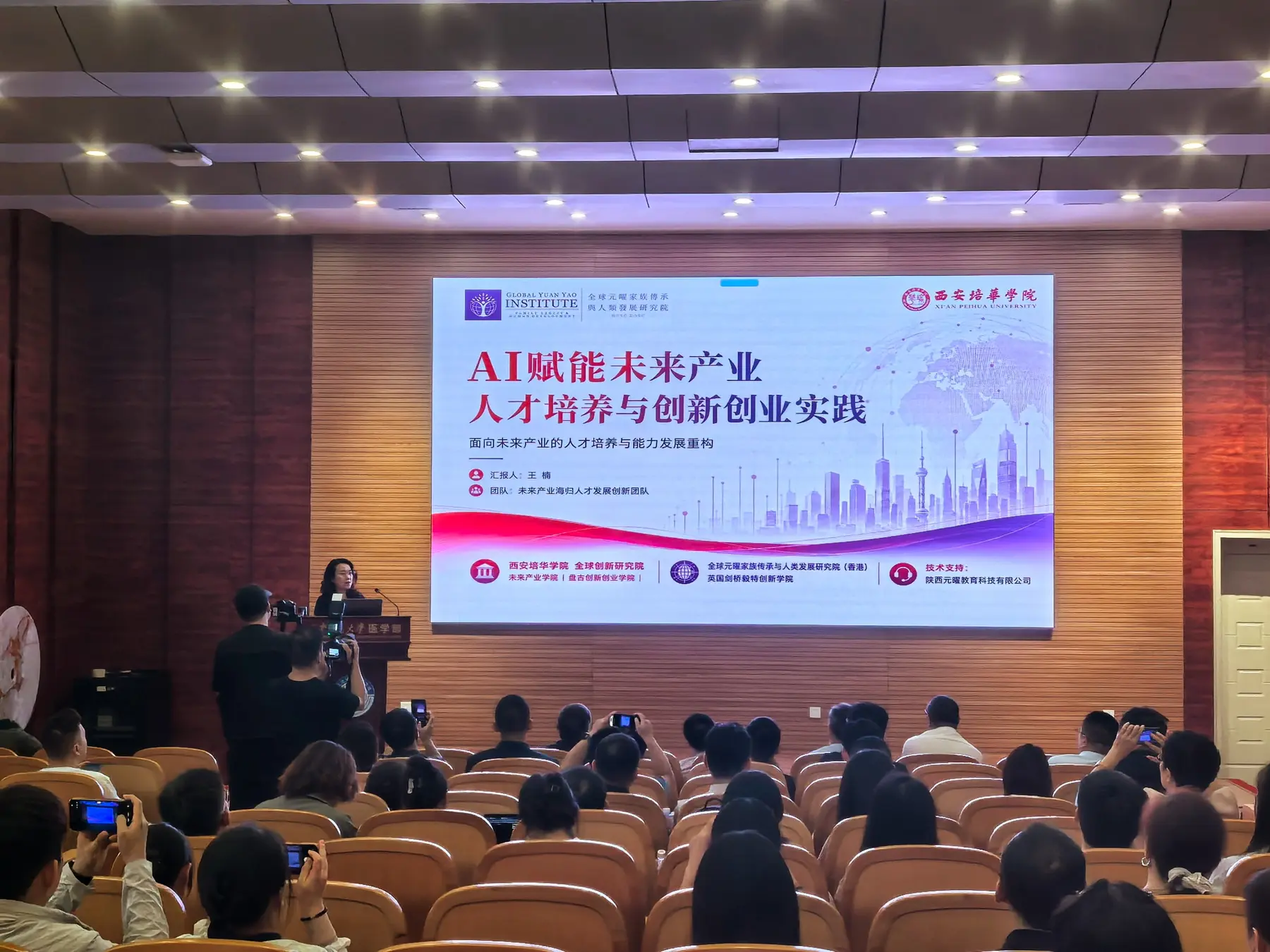
The research argues that the impact of AI extends far beyond technological change. As artificial intelligence becomes increasingly embedded in learning, work, content creation and organizational decision-making, the challenge for education is no longer simply how to help people use AI. A deeper question is emerging: As more knowledge-based and cognitive tasks can be supported by AI, what remains distinctly valuable about human capability?
The research team proposes that future talent development must extend beyond AI proficiency to include human judgment, creativity, interdisciplinary collaboration, real-world problem-solving, career adaptability, global competence and cultural understanding — and examine how these capabilities develop across different educational, cultural and industrial environments.
“What we need to discuss is not only which jobs AI may replace, but what education should help a person become as technology continues to expand the boundaries of human capability,” said Echo Wang-Nan, Founder and President of the Global YuanYao Family Legacy & Human Development Institute (Hong Kong). “The future is not simply about humans competing with AI. It is about whether people can work with AI while continuing to develop the judgment, creativity, connections and problem-solving capabilities needed to navigate complex challenges.”
From AI Capability to Human Development
The research has grown out of the team's ongoing work across higher education, innovation and entrepreneurship education, youth development and industry-based practice.
Much of the current discussion around AI and education has focused on technology adoption, AI literacy, technical curricula and productivity. These remain important. Yet as generative AI becomes increasingly integrated into learning, professional work and organizational decision-making, the research team argues that proficiency with AI tools alone may no longer constitute a sustainable talent advantage.
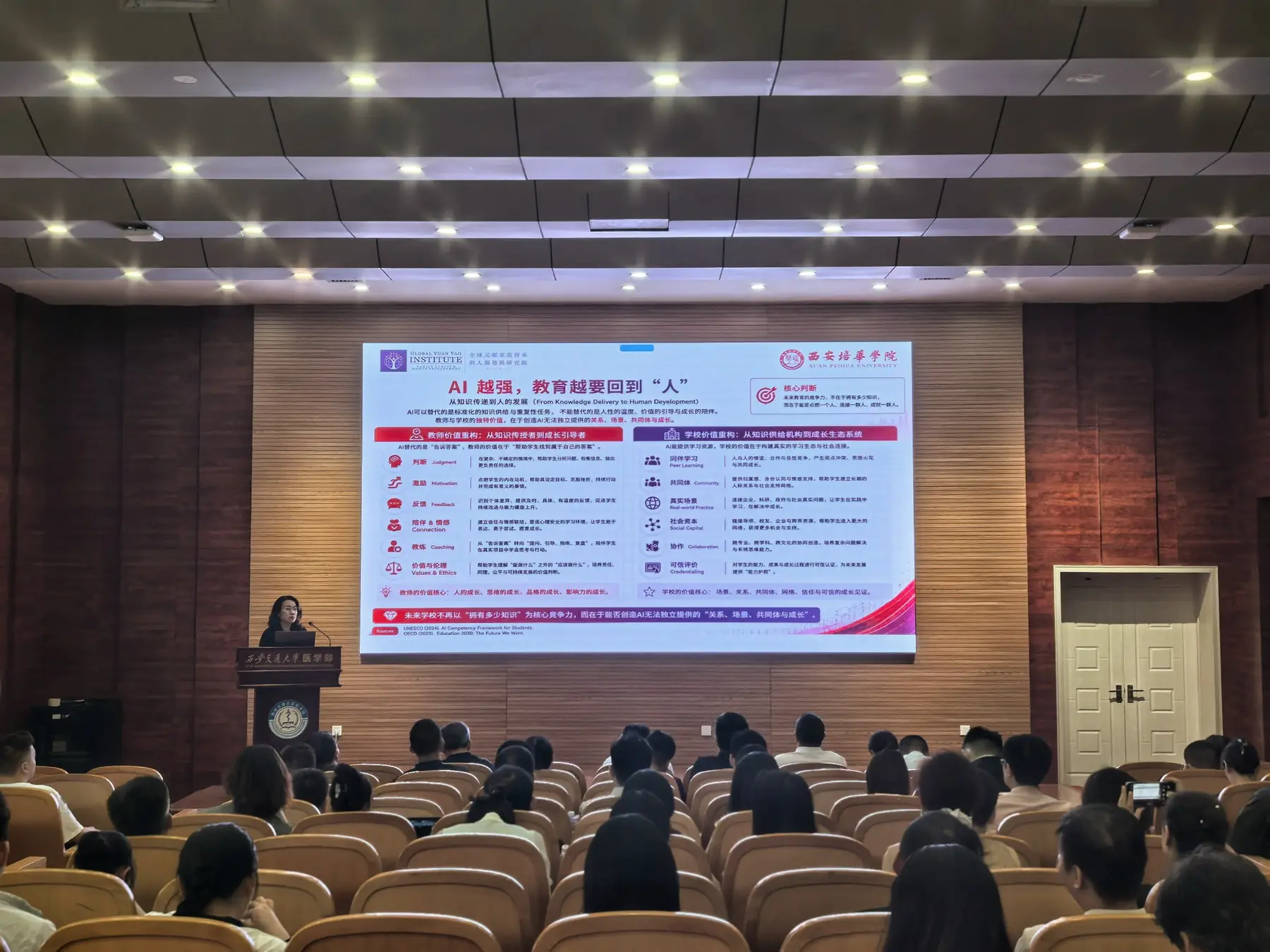
The team is therefore developing a Future Talent Development Framework that examines technological capability and human development within the same system. The framework explores how higher education, innovation and entrepreneurship, real-world industry projects and career development can be connected, while shifting attention from a relatively static knowledge-and-skills model toward an individual's capacity to judge, act, adapt and continue developing in rapidly changing environments.
AI Is Going Global. Talent Is Still Shaped by Culture.
A distinctive dimension of the research is its inclusion of culture and place in the future-talent framework.
Artificial intelligence is dramatically reducing the cost of moving knowledge and information across geographic boundaries. Human development, however, does not take place in a vacuum.
Values, communication styles, approaches to innovation, attitudes toward risk, career choices and even definitions of success are shaped over time by families, education systems, social structures, industries and cultural traditions.
The research therefore challenges the assumption that the future of talent can be represented by a single universal model. Instead, the team is exploring a proposition that will form part of its continuing research: Future talent development should combine global competencies with locally rooted strengths.
Different regions have different industrial structures, educational resources, cultural environments and patterns of international connectivity. Those differences may, in turn, contribute to distinctive talent profiles.
The question for future research is therefore not only “What capabilities will the world need?” but also: Which capabilities are becoming globally shared, and how will different cultures, places and industrial ecosystems shape different forms of future talent?
Why Xi'an?
Xi'an provides a distinctive setting in which to explore that question.
More than a thousand years ago, Chang'an — the historical name associated with Xi'an during several Chinese dynasties and especially the Tang era — was one of the world's major cosmopolitan cities, where people, goods, knowledge, ideas and cultures from different regions interacted.
Modern Xi'an and the wider Shaanxi region represent a different intersection: a dense concentration of universities and research institutions combined with engineering talent, advanced manufacturing, hard technology industries and a deep cultural heritage.
This ecosystem differs in important ways from those of China's major coastal economic regions. The Yangtze River Delta and Pearl River Delta, including the Guangdong-Hong Kong-Macao Greater Bay Area, have developed talent environments strongly influenced by digital industries, international commerce, market-driven innovation and global capital flows. Shaanxi and parts of Western China offer a different combination of research universities, engineering, advanced manufacturing, hard technology and cultural heritage.
The research does not seek to rank these ecosystems. Instead, it raises another question: Do different cultural and industrial ecosystems shape different kinds of future talent?
If they do, developing globally capable talent may require more than replicating a single successful model. It may require enabling young people to build global capabilities while transforming the distinctive strengths of their own cultural, educational and industrial environments into future-facing advantages.
From the cross-cultural exchanges of ancient Chang'an to the new global flows of knowledge accelerated by AI, Xi'an offers a meaningful starting point for this discussion.
From University Classrooms to Real-World Industry
The research is intended to move beyond a purely conceptual framework.
The team is exploring applications across higher education, innovation and entrepreneurship education, and real-world industry projects. Through practice involving students, educators, companies and participants from different disciplinary backgrounds, the initiative will continue to examine how AI affects capability development, project collaboration and the transition from education into professional life.
The research team also officially launched the YuanYao Future Talent Development and Innovation Practice Platform V1.0. Designed to connect future talent development with innovation and entrepreneurship practice, the platform brings together talent assessment, learning, mentoring, real-world industry projects, student participation and outcome feedback within a digital environment.
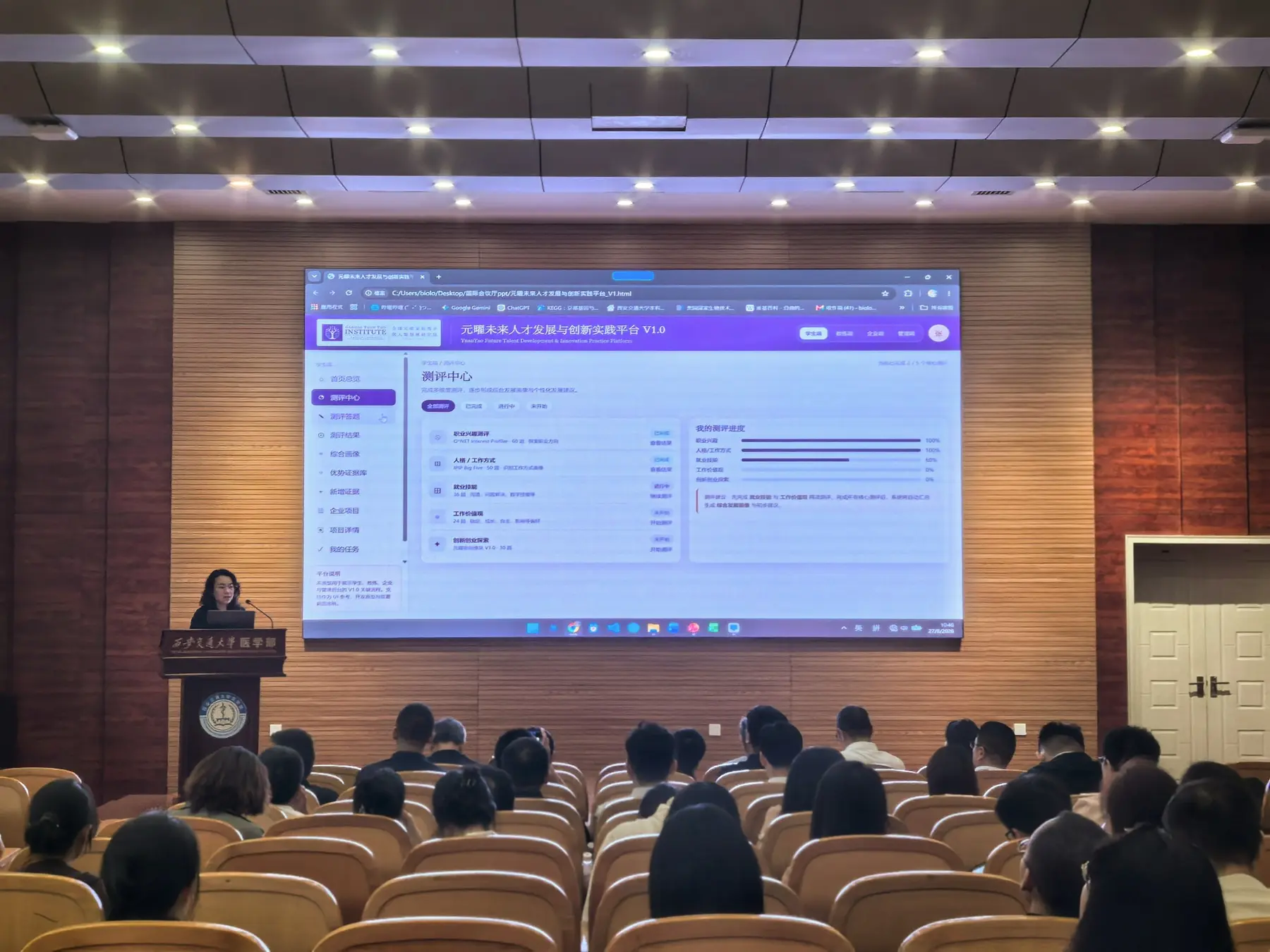
As a practical extension of the research initiative, Platform V1.0 will be used to test and refine the Future Talent Development Framework in real educational and industry settings, while building a growing evidence base of talent-development, project-based learning and university-industry collaboration cases through a continuous research-practice-feedback-iteration cycle.
The objective is not simply to develop more people who know how to use AI. It is to explore how education can help young people identify meaningful problems, form sound judgments, organize resources, collaborate across boundaries and translate ideas into action under conditions of uncertainty.
The research was presented and discussed on Aug. 27 during a thematic training program on artificial intelligence held at the International Conference Hall, Yanta Campus, Xi'an Jiaotong University.
The event was held under the guidance of the Shaanxi Provincial Data and Government Services Center and organized by the Shaanxi Provincial Western Returned Scholars Association. It was undertaken by the association's Youth Committee, the China Unicom Xi'an Software Research Institute, and the Xi'an Jiaotong University Association of Overseas-Educated Scholars, with support from the Joint Party Branch of Faculty and Students, Department of Physiology, Xi'an Jiaotong University.
The program brought together representatives from government, universities, research institutions and the technology sector to exchange perspectives on artificial intelligence applications, industrial innovation and talent development.
Building a Cross-Cultural Research Network on Future Talent
The research initiative was launched by the Global YuanYao Family Legacy & Human Development Institute (Hong Kong).
Its research network brings together researchers and practitioners with backgrounds spanning education, psychology, business, innovation and entrepreneurship, artificial intelligence and industry, with the aim of examining human development in the age of AI through interdisciplinary and cross-cultural perspectives.
ELITE Innovation College Cambridge (UK) provides academic support for the research initiative. Its President will serve as an academic advisor as the project expands its work in international comparison, innovation education and global talent development.
The next stage of the research will broaden its university, industry and international comparative samples, with particular attention to distinctive human capabilities in the age of AI, future talent structures, cultural and regional talent ecosystems, global competence, and the relationship between education and emerging industries.
International White Paper Planned for Launch at the University of Cambridge in 2027
Building on the research, the Global YuanYao Institute has begun developing the Global Future Talent Development in the Age of AI White Paper.
The white paper will bring together evidence from education research, industry needs, talent-development practice, and regional and cross-cultural cases. It will examine the changing nature of human value in the age of AI, future talent capabilities, global competence, cultural and regional talent ecosystems, higher education innovation, innovation and entrepreneurship education, career adaptability, and university-industry collaboration.
The research team plans to hold the international launch and academic exchange for the white paper at the University of Cambridge in 2027, bringing together educators, researchers and industry practitioners from different countries and regions for an international dialogue on the future of talent.
From Xi'an to Cambridge, and from the cross-cultural exchanges once represented by ancient Chang'an to the accelerating global flows of knowledge and talent in the age of AI, the initiative will continue to explore a deceptively simple question that technology is forcing societies to reconsider: As technology becomes increasingly capable, how should we develop human capability and value?